When parents attend an NCE tryout, they often expect to see the same evaluation process used in club soccer. At NCE we look at things in a totally different way.
Our approach is built around our Elite Soccer Pathway. That means we are not selecting players for the next season. We are selecting players for who we believe they can become in three, five, or even ten years.
That distinction changes everything.
The Fundamental Difference: Impact vs. Potential
Most clubs operate on a one-season commitment. Coaches are judged by results. Teams are evaluated by wins, rankings, and league performance. That reality creates pressure.
When a club coach selects a roster, they often prioritize immediate impact. A physically dominant player who can help win games now may be chosen over a smaller player with higher long-term upside.
This is not because club coaches lack knowledge.
It is because their structure makes long-term projection difficult. They need short-term success to sustain their team, their roster, and sometimes their position.
At NCE, we are not selecting for immediate dominance. We are selecting for long-term player development. That allows us to make different decisions.
We can look beyond size. We can look beyond early physical maturity. We can look beyond who wins today’s small-sided game.
We focus on predictors of future success.
This is proven by the many email responses we receive following rejection decisions. Unhappy parents often can’t believe that we have overlooked their son or daughter who plays on a “top team” at a “top” club and leads the team in both goals and assists. How could we fail to see how good he or she is?
In reality, none of those factors matter to us. We see through the noise surrounding leagues and trophies and deliberately ignore a player’s current effectiveness in youth games. In fact, if a young player is dominating peers in goals and assists, it can sometimes indicate early physical development rather than long-term projection.
See our post: “The Curse of the Early Developer→”
Why Our Model Mirrors Professional European Soccer Academies
This methodology is not theoretical.
It comes directly from the professional academy system in Europe — the environment I grew up in and coached within. It is the system that shaped our staff.
Professional European soccer academies do not select based on short-term impact. They select based on projected future ceiling.
When I was developed within that environment, and later coached within similar systems, selection decisions were always framed around one question:
What will this player look like at 18 or 21 — not at 12 or 14?
That mindset is second nature to us.
Lee, Scott, Paul, Hugo, and I were raised in that system. It informs how we evaluate technical quality, physical profile, psychological strength, and social maturity.
It is simply how we see the game.
The Key Competencies We Look For at NCE Tryouts
When evaluating players within our High-Performance Soccer Training model, we assess across five core categories: Technical, Tactical, Physical, Psychological, and Social.
We are not looking for perfection. We are looking for traits that predict growth.
Technical Foundations: The Non-Negotiable Base
Technical quality forms the foundation for all future growth.
Ball mastery.
First touch.
Passing and receiving skills.
Running with the ball.
If these foundations are weak, future progress becomes limited because the player lacks the base to build upon.
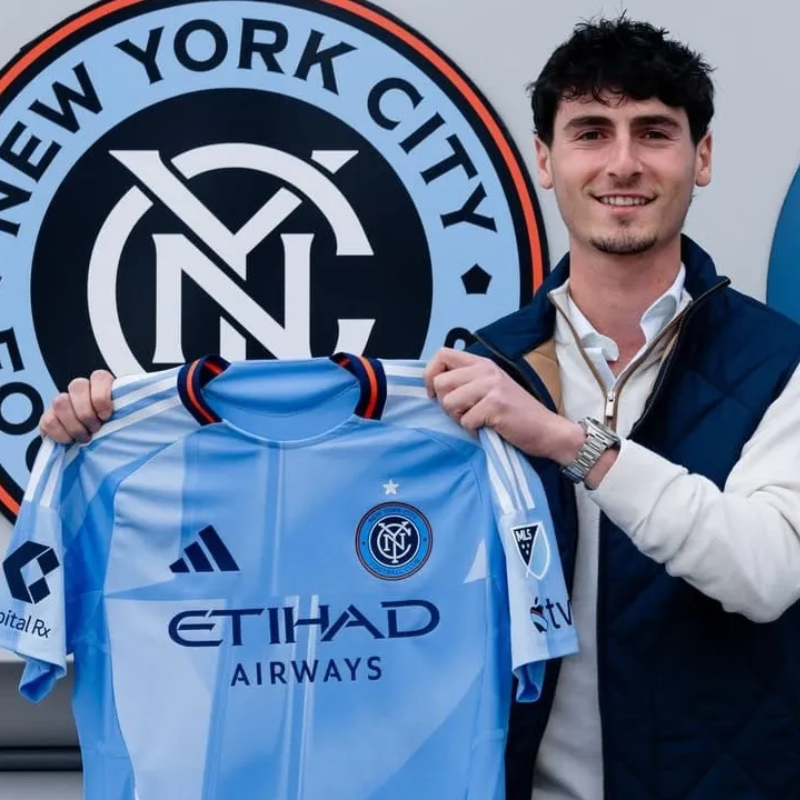
When we coached Maximo Carrizo at Purchase College in Westchester, his technical clarity was evident early. He was quiet, composed, and consistently clean with the ball. Those traits projected forward. Today, he is part of New York City FC’s first-team environment.
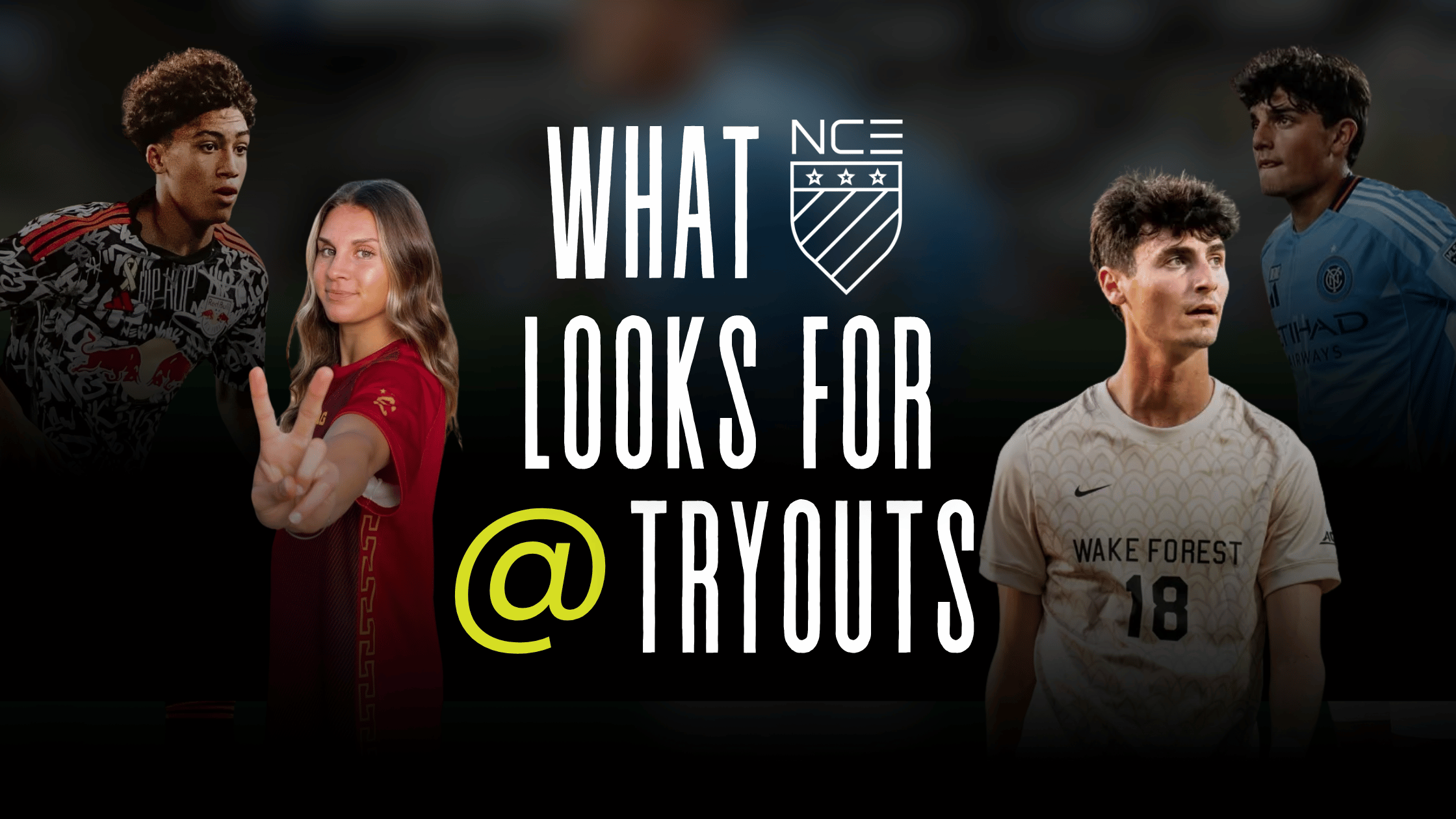
The same was true when we worked with Julian Hall at Superdome Sports in Waldwick. Even at a young age, he was technically efficient, physically balanced, and mentally steady. That profile — not just goals scored — indicated long-term potential. He is now scoring goals for the New York Red Bulls first team.
Technical foundations travel. They age well.
Physical Profile: What We Value (And What We Don’t)
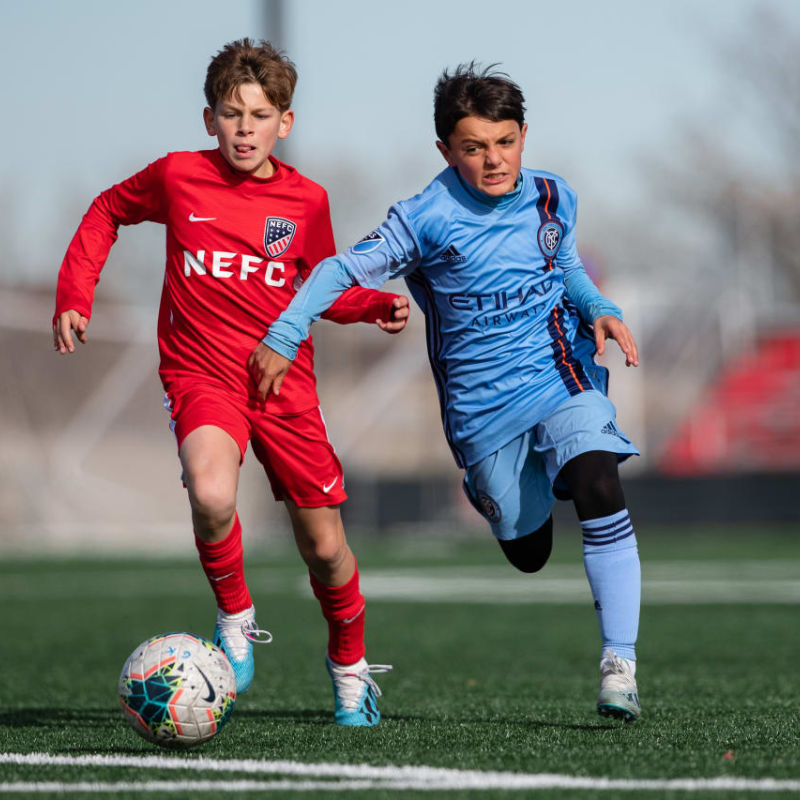
Many club tryouts heavily reward strength, power, and early physical dominance.
We understand something different.
Strength and power often equalize over time as late developers mature. Selecting heavily on early physicality is a poor long-term predictor.
Instead, we prioritize:
- Balance
- Coordination
- Agility
- Movement efficiency
These attributes persist. They scale with growth. They support technical execution under pressure.
When we coached Taylor Jenkins in Connecticut, she may not have been the most technically refined player at that stage. But her athletic coordination, balance, and relentless work rate were unmistakable. She later progressed to Division I soccer at both the University of Connecticut (UConn) and the University of Southern California (USC) and into a professional environment at Hartford Athletic.
Her profile projected forward.
Psychological & Social Competencies: The True Separators
This category is often the strongest predictor of long-term success.
- Coachability.
- Determination.
- Work rate.
- Humility.
- Growth mindset.
Without these traits, development in the other core categories stalls.
Players without internal standards often take shortcuts during critical development phases. They avoid uncomfortable learning moments. They protect ego rather than improve performance.
When we coached Cooper Flax on Long Island, his technical level was solid. What truly stood out was his attitude. When I took him to Everton and Wolves on trial as a young player, he did not secure contracts.
But his response mattered.
He absorbed feedback. He reflected. He improved. That coachability and internal drive became the engine of his development. He later progressed through Wake Forest and into the professional ranks at NYCFC.
Psychological traits compound over time.
Why Clubs Often Cannot Select This Way
This distinction is structural.
If a club selects a smaller, technically gifted, psychologically strong player who will mature in two years — but leaves out a physically dominant player who wins games now — they risk short-term results.
Short-term results influence retention. Retention influences revenue. Revenue influences survival.
So immediate impact frequently wins.
NCE does not operate under that pressure.
We are building a structured Elite Soccer Pathway designed for progression, not short-term trophies.
That freedom allows us to select players based on projection, not present dominance.
A Pattern We Have Seen Repeatedly
When you step back and look at the players who have progressed through the NCE environment into professional or Division I pathways, a pattern emerges:
Technical proficiency early. Efficient movement patterns, particularly balance and coordination. Coachability. Relentless internal standards.
Those traits predict trajectory.
They are not always the loudest attributes at age 10. But they are the most durable.
What This Means for Parents at Tryouts
If your child is not the biggest or fastest today, that does not eliminate long-term potential.
If your child is coachable, technically engaged, coordinated, and internally driven, those qualities matter more to us than temporary physical dominance.
Our responsibility is not to select the best player today.
Our responsibility is to identify who can become the best player tomorrow.
That is the difference between short-term team building and long-term player development.
That is the foundation of our Elite Soccer Pathway.
Next Steps
If you want to understand how this selection model integrates into our full development structure, explore:
Every environment within NCE is aligned around one principle:
Select for potential. Develop with standards. Project forward.
That is how professionals are built.