
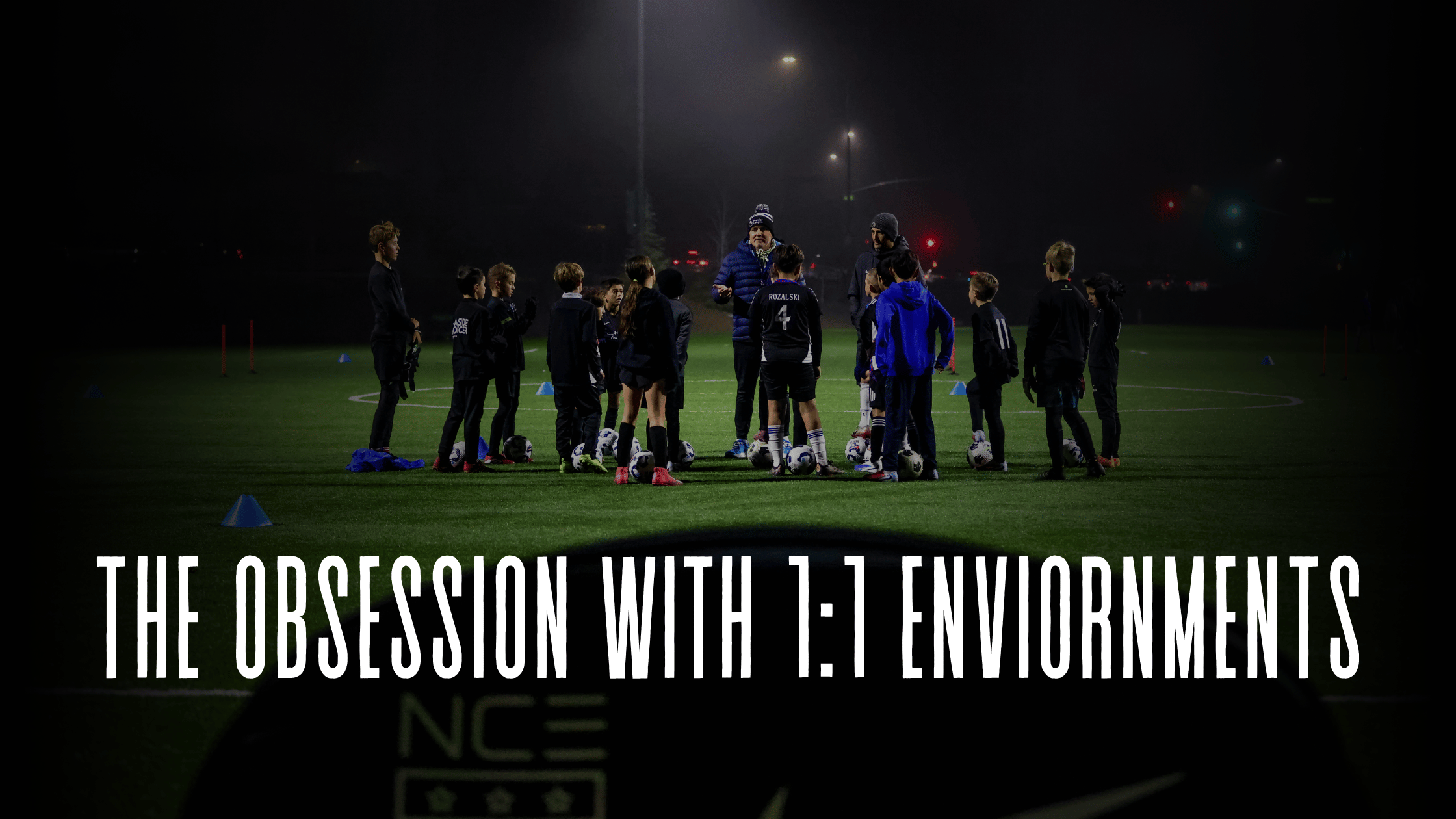
Since arriving in the U.S., one difference in youth soccer culture has stood out immediately: the obsession with one-to-one and very small group training.
Private sessions. Groups of one to four players. The assumption that fewer players automatically means better development.
It’s not a fringe belief — it’s widespread. Even today, many NCE parents instinctively feel more comfortable when training groups are smaller, believing their child will receive more personal attention and therefore improve faster.
The logic feels sound. But it doesn’t reflect how elite player development actually works.
My Experience in European Professional Environments
Across my years as a professional player, and later working in and around professional academies in Europe, one-to-one on-field training was virtually nonexistent.
Not rare. Not occasional. Essentially absent.
The only times I ever saw genuine one-to-one work were:
- With a physiotherapist, during injury rehabilitation or return-to-play
- With a goalkeeper coach, where the position’s demands are fundamentally different
For outfield players, development was delivered almost exclusively through group and team-based training.
That wasn’t due to a lack of resources. Professional academies have more staff, more time, and more access to players than almost any youth environment. They avoided one-to-one training because they understood something critical:
Removing players from game complexity weakens learning.
Why One-to-One and Very Small Groups Are Less Effective
One-to-one and small group sessions can look impressive. They feel intense. They feel focused.
But football is not a closed skill sport.
In a match, players must:
- Scan constantly
- Process multiple cues at once
- Make decisions under pressure
- Coordinate actions with teammates
- Adapt to opponents, space, and time
- Manage emotion, fatigue, and momentum
None of this can be meaningfully trained in isolation.
With one to four players:
- Decision-making becomes predictable
- Pressure is artificial or inconsistent
- Tactical relationships disappear
- Timing, spacing, and movement lose context
Ironically, the fewer players you have, the harder it becomes for the coach. It’s far more difficult to recreate realistic problems when there simply aren’t enough variables on the field.
More attention does not equal better development if the environment itself is stripped of reality.
Why Training Groups of 8–18 Players Matter
Elite environments prioritize game realism, not cosmetic individualization.
Training groups in the range of 8–18 players allow coaches to:
- Replicate real match pictures
- Train scanning and awareness properly
- Introduce genuine pressure and unpredictability
- Develop positional relationships
- Create decision-making consequences
- Layer technical, tactical, physical, psychological, and social demands together
Within these environments, players still receive individual development — just not individual isolation.
Constraints, roles, feedback, and challenges can all be adjusted for the individual, while learning remains embedded in the game.
This is how professional academies bridge the gap between training and competition.
Why NCE Trains This Way
At NCE, we deliberately aim to structure training groups in this 8–18 player range whenever possible.
Not because it’s easier — it isn’t. Not because it looks better — it often doesn’t.
But because it allows us to:
- Simulate the real demands of the game
- Individualize learning within a team context
- Prepare players for competitive environments, not just training sessions
When groups are too small, the coach ends up compensating for missing complexity. When groups are appropriately sized, the game itself becomes the teacher.
Reframing the Conversation for Parents
The right question isn’t: “How many players are in the session?”
It’s: “How closely does the session reflect the demands of the game — and how is my child being challenged within it?”
That shift in perspective is often the difference between short-term polish and long-term progress.
Why NCE Trains This Way
At NCE, we deliberately aim to structure training groups in this 8–18 player range whenever possible.
Not because it’s easier — it isn’t. Not because it looks better — it often doesn’t.
But because it allows us to:
- Simulate the real demands of the game
- Individualize learning within a team context
- Prepare players for competitive environments, not just training sessions
When groups are too small, the coach ends up compensating for missing complexity. When groups are appropriately sized, the game itself becomes the teacher.
