
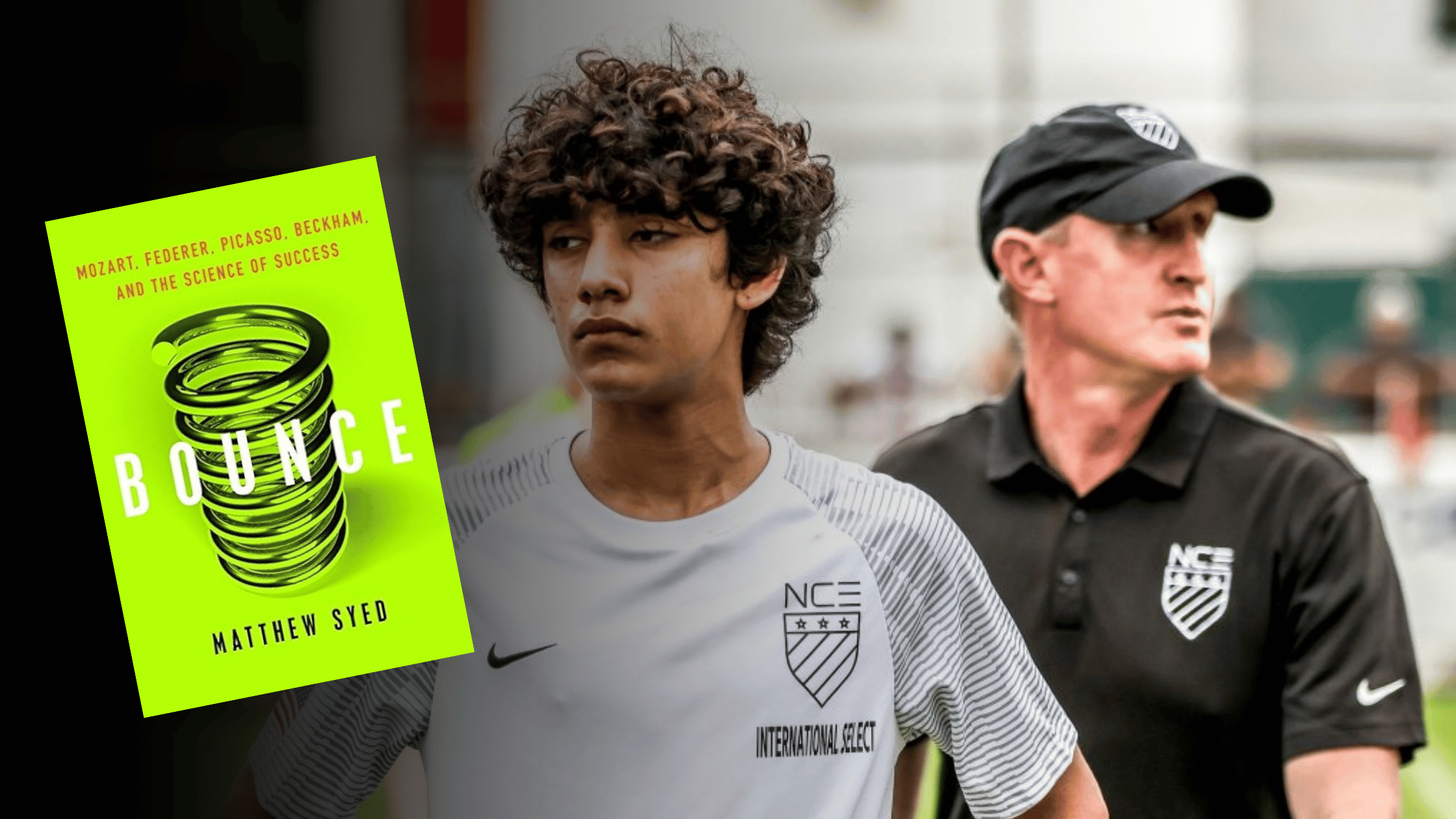
Reading Bounce by Matthew Syed was a turning point for me. Until then, I believed ability was inherited — that some players were born with it and others weren’t. I included myself in that first group.
But Bounce dismantled that idea completely. It showed me that success isn’t born from genetics — it’s built through environment, opportunity, and repetition.
I only wish I’d read it earlier, when I was still playing. Because once you understand that talent is developed, not gifted, you start to see the game — and yourself — very differently. You realise that every skill, every level of performance, is the result of thousands of unseen moments: hours of practice, people who guide you, and environments that challenge you to grow.
How Environment Shapes Athletic Development
I was lucky — I grew up in a football and sports-mad family. Sports were everywhere. Footballs, netballs, tennis balls, cricket balls, hockey balls, golf balls — they were scattered around the house, garden, and street from the day I was born. I had active parents and grandparents who played with me constantly, and crucially, I had an older sibling who dragged me into games that pushed me beyond my age.
That environment — not genetics — shaped me. It taught me coordination, competitiveness, resilience, and most importantly, a love for the game.
What I eventually realised was that what we often call “natural ability” is really just early development.
Early Physical Competencies and Long-Term Success
The core physical competencies that are critical to becoming good at any sport — balance, coordination, agility, spatial awareness — are developed very early. Sometimes before a child can even walk.
Physical play — the wrestling, the rough-and-tumble, the chasing, the climbing, the “rough daddy play” — all of it builds those fundamental physical skills. It teaches body control, timing, and reaction. It builds confidence in movement. And all of those things lay the foundation for every sporting skill that follows.
So when I look back, it’s clear I wasn’t born talented. I was developed by my environment — by the people around me, the culture of play, and the endless opportunities to move, compete, and learn.
The Bounce Story: Talent Built Through Repetition
That’s exactly what Matthew Syed discovered when he looked back on his own journey in Bounce. As a young table tennis player growing up in Reading, England, Syed lived on a street that, by pure chance, produced more top table tennis players than anywhere else in the country. Not because of genetics, but because of the environment.
Just down the road was a local sports hall run by a passionate coach who opened it up every evening. Syed and his friends spent countless hours there — hitting thousands upon thousands of balls, experimenting, failing, learning. The perfect combination of access, opportunity, and culture.
It wasn’t talent that created champions — it was the environment that encouraged practice and rewarded persistence. Syed’s story and my own reinforce the hypothesis that excellence isn’t born in the genes — it’s built in the gym, the park, the street, the backyard.
Coaching Philosophy: Building Environments for Growth
And that’s what truly changed how I think about coaching. Because if talent can be developed, then our job as coaches is not to identify the gifted few, but to create the right environments for growth — places where players are inspired to train, to fail, to improve, and to fall in love with the process.
That’s the philosophy we live by at NCE Soccer. We build environments where players can learn, struggle, adapt, and grow — because potential isn’t born. It’s built.
The Modern Childhood Challenge
But when I look at childhood today, I worry we’re losing some of those environments that shaped us. Kids spend less time climbing trees, kicking balls in the street, and wrestling with their siblings — and more time in structured sessions or behind screens. The freedom to play, fall, and figure things out physically is disappearing.
If we want the next generation to thrive — not just in sport, but in life — we need to give them that freedom back. To create homes, schools, and clubs that encourage movement, curiosity, and play. Because it’s not talent that builds champions — it’s the environment we build around them.
